Upgrade Your Indoor Air Quality with a Whole House Humidifier


Choosing a Whole House Humidifier for Your Home
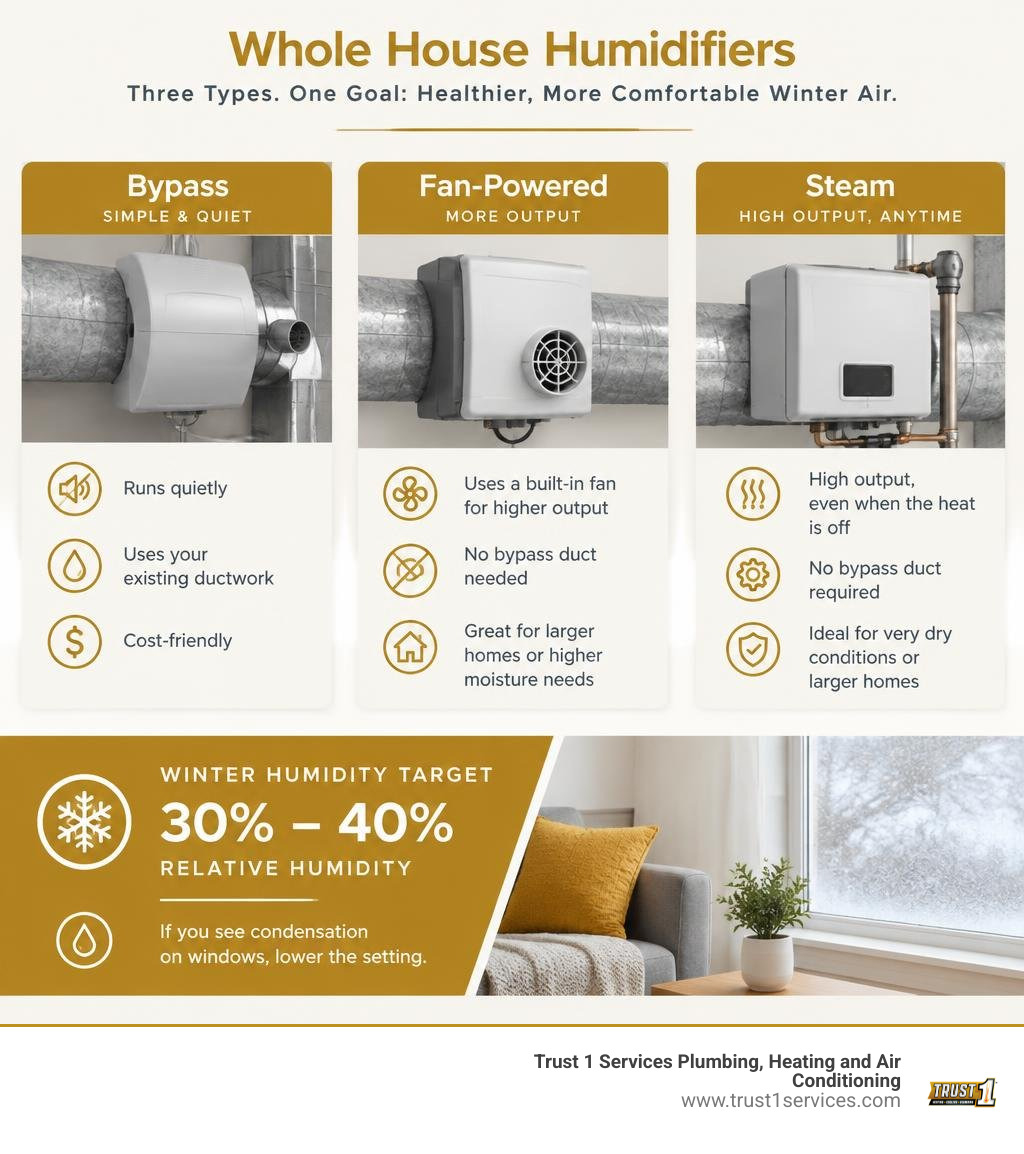
Does your Quincy home feel dry and uncomfortable when the heat turns on? A whole house humidifier adds moisture through your home’s HVAC system to ease dry winter air. For a Quincy home, the main choices are bypass (simple and quiet), fan-powered (more output without a bypass duct), and steam (high output even when the heat is off). The right choice depends on your home’s size, how much moisture it loses, and your budget.
Start by checking your indoor humidity. Proper sizing and installation matter as much as the type you choose.
Trust 1 Services Plumbing, Heating and Air Conditioning brings local HVAC and plumbing experience to help Quincy homeowners weigh the right whole-house humidifier options for their homes.
Core Benefits: Why Indoor Moisture Balance Matters in Winter
As cold weather settles across Massachusetts in late November, heating systems run more often to keep homes warm. But as cold outdoor air warms up indoors, its relative humidity drops. Relative humidity measures how much moisture the air holds compared with the most it could hold at that temperature. Indoor air can become very dry during a New England winter.
This desert-like air pulls moisture directly out of your skin, woodwork, and furnishings. Our guide to choosing a whole-home humidifier for dry winter air explains how proper moisture levels can improve comfort and energy efficiency.
Humid air retains heat better than dry air and slows down the evaporation of moisture from your skin. When your air contains sufficient moisture, you naturally feel warmer at lower room temperatures. You may be able to lower your thermostat by two or three degrees and still feel comfortable. This can help lower winter heating bills.
Balanced humidity also protects your home’s structure. Dry winter air causes hardwood floors to shrink, gaps to open in trim, and musical instruments or delicate wooden furniture to crack. Steady indoor humidity helps protect wood from damage as it dries and shrinks.
Understanding how winter heating and cooling systems operate helps explain why moisture management is a fundamental part of whole-home comfort. When conditioned air flows evenly through your ductwork with optimal moisture, your equipment operates more efficiently.
Why Invest in a Whole House Humidifier for Winter Comfort
Dry air can dry out the lining of your nose and throat and worsen discomfort. Balanced humidity may help limit how long some viruses survive in the air. Avoid excess moisture, which can encourage dust mites.
Portable room humidifiers can add moisture to a single bedroom, but you must refill their tanks and clean them often to limit mineral and bacteria buildup. By contrast, a whole-home system connects to your central HVAC ductwork, draws water automatically from your plumbing, and distributes moisture through the ducts.
| Feature | Whole House Ducted Humidifier | Portable Console Unit | Single-Room Ultrasonic (makes mist with sound vibrations) |
|---|---|---|---|
| Coverage Area | 3,000 to 6,250 sq. ft. | Up to 3,600 sq. ft. | 250 to 500 sq. ft. |
| Water Supply | Automatic plumbed water line | Manual 3 to 5-gallon tank refills | Manual 1-gallon tank refills |
| Setup | Professional HVAC and plumbing connections | Fill tank and position unit | Fill tank and position unit |
| White Dust Risk | Zero (evaporative or steam) | Zero (water evaporates from a wet wick) | High (unless using distilled water) |
| System Control | Digital central humidity control | On-unit dial or manual speed | Basic onboard switch |
Stand-alone console humidifiers can help homes without ductwork.
Comparing Whole House Humidifier Types and Technologies

Central humidifiers come in three main types: bypass, fan-powered, and electrode steam. They use airflow and heat in different ways to add moisture.
Evaporative Bypass and Fan-Powered Systems
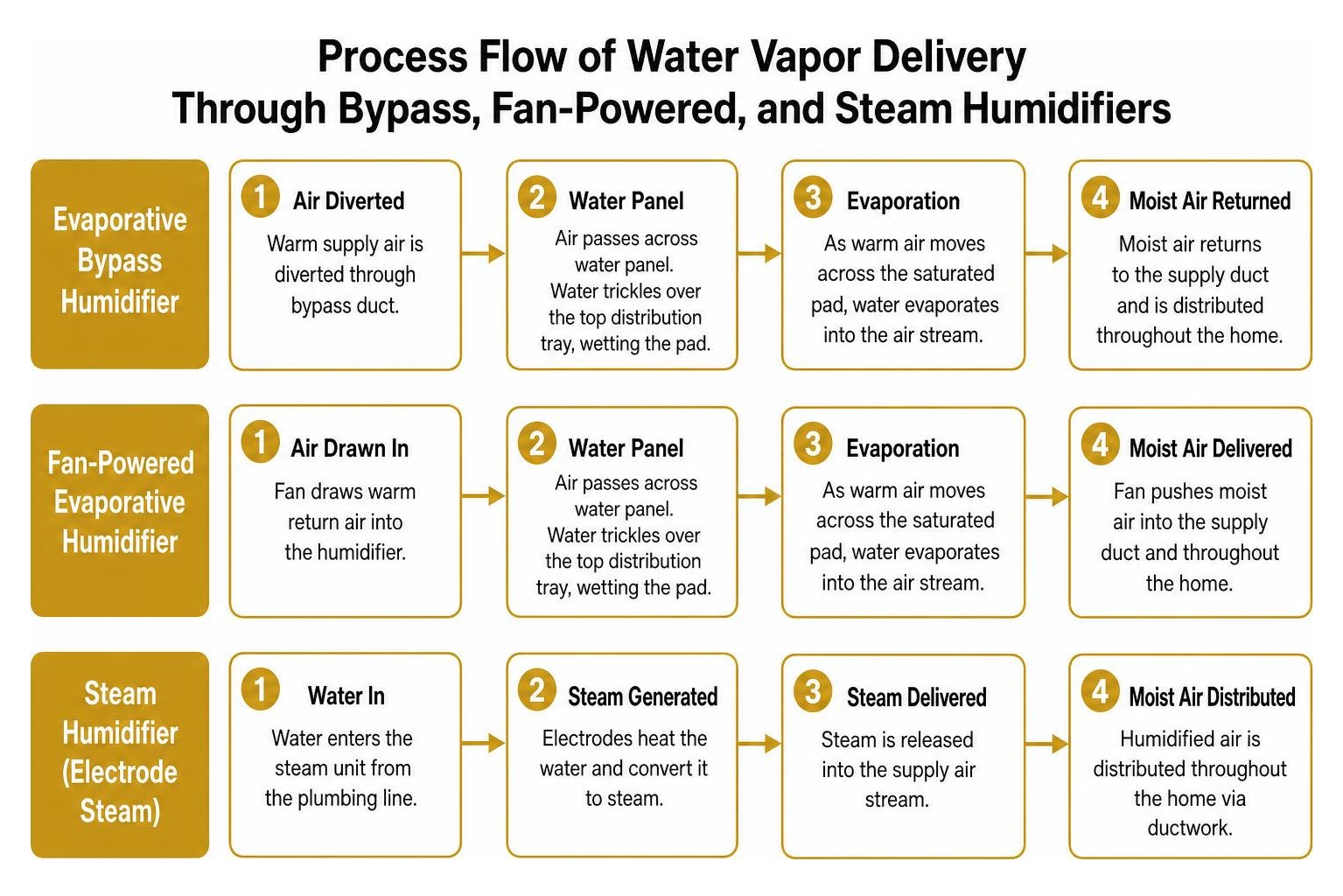
Evaporative systems use an internal water panel or expanded aluminum pad. A tray spreads water over the pad. Warm air passes through the wet pad and picks up moisture as the water turns into invisible vapor.
Bypass humidifiers use the pressure difference between supply ducts, which send warm air to rooms, and return ducts, which carry air back to the heating system. A round bypass pipe directs some warm supply air through the humidifier pad and returns it to the duct system. Modern bypass designs can provide steady moisture for many homes while using simple, reliable parts.
Fan-powered units mount directly to the supply plenum, the main chamber that feeds warm air into your ducts. They do not need extra bypass ductwork. An internal fan pulls warm air across the water panel and pushes moisture into the supply air stream.
High-output fan-powered humidifiers can serve larger homes when the heating system has enough runtime and airflow. Automatic controls can adjust operation as indoor conditions change, helping prevent both overly dry air and excess window condensation.
Dedicated Electrode Steam Humidifiers
Electrode steam systems offer humidity control without relying on furnace heat. They use electrodes, metal parts that pass electricity through water, to boil water inside a replaceable plastic canister. The unit then sends steam into the supply airflow through a tube that spreads it into the moving air.
When humidity drops, the unit can run the central HVAC blower and add moisture on demand. This makes steam an option for larger homes or homes where the furnace runs less often.
Electrode steam systems need minerals in the water to carry electricity. They generally use tap water rather than reverse-osmosis water, because reverse osmosis removes most minerals. Electrical conductivity measures how well water carries current. Some models specify a range of 125 to 1,250 microsiemens per centimeter; your installer should check the model’s water requirements. If your home has hard water, discuss water filtration with your installer to make sure any treatment fits those requirements.
Key Factors for System Sizing and Integration
Choosing the right capacity involves more than just measuring your floor space. Installers measure humidifier output in gallons per day (GPD). To choose the right output, they check your home’s size, how much air leaks through its walls and roof, and how cold your winters get.
Carrier whole-house humidifiers range from 11.5 to 34 gallons of water per day to accommodate properties from 500 up to 4,000 square feet. Older homes with loose air sealing and drafty framing allow indoor moisture to escape quickly, requiring a unit with higher GPD output. Tightly air-sealed modern homes retain moisture much better and need smaller evaporative or bypass units to maintain ideal humidity.
Selecting the Right Whole House Humidifier Size for Your Home
An installer can compare your options by checking the size of your heated living space, its insulation, and its air leaks:
- Tight Construction (Modern homes with layers that slow moisture movement and seals that limit air leaks): Needs roughly 0.5 gallons per day for every 1,000 square feet of living space.
- Average Construction (Standard homes with insulated walls and double-pane windows): Needs roughly 1.0 gallon per day for every 1,000 square feet.
- Loose Construction (Older homes with drafty windows and unsealed framing): Needs 1.5 or more gallons per day for every 1,000 square feet.
Help keep air moving through your system with regular HVAC filter replacements. Clean filters help air flow through the ducts and carry added moisture throughout the house.
Professional Installation and Code Compliance
Installing a central ducted humidifier involves cutting sheet metal, connecting plumbing, wiring low-voltage controls, and adding drainage. The installer should use a dedicated quarter-inch copper or braided stainless-steel water line with a ball valve to shut off the water. This avoids a saddle valve, which clamps onto and pierces an existing pipe.
Our licensed technicians at Trust 1 Services Plumbing, Heating and Air Conditioning check that water supply lines, drains, and transformers that lower voltage for the controls meet local Quincy building and plumbing codes. If you are upgrading your heating equipment this season, planning a humidifier alongside your heating installation helps your installer match the equipment and controls.
The Mass Save HEAT Loan offers 0% interest financing up to $50,000 for eligible energy-saving upgrades, such as heat pumps and high-efficiency boilers. Its funds do not cover add-on accessories like humidifiers and air cleaners. When we prepare project quotes, we list these comfort accessories separately so you can distinguish their costs from eligible upgrades.
Frequently Asked Questions About Whole-Home Humidity
What is the ideal indoor humidity level during cold months?
Aim for indoor relative humidity between 30% and 40% during the heating season. When outdoor temperatures fall below freezing, you may need to lower the humidity setting to 25% or 30%. A lower setting helps keep moisture from collecting on cold windows or inside walls. Lower the setting if you notice window condensation.
Can a whole-home humidifier cause mold inside ductwork?
A humidifier can contribute to mold if excess moisture collects inside ductwork. Proper sizing, airflow, drainage, and humidity controls help reduce that risk. Older drum-style humidifiers held water in a tank. Modern flow-through units send fresh water over a pad and drain away the extra water. Steam units send vapor into moving air. Installers should set up these systems with switches that check airflow to help prevent condensation.
Enhancing Your Home Comfort with Professional HVAC Solutions
Before choosing a unit, have an installer assess your home’s moisture needs and confirm which options fit your HVAC system.
Trust 1 Services Plumbing, Heating and Air Conditioning offers upfront pricing, same-day scheduling, and a 100% satisfaction guarantee with its indoor air quality assessments, equipment sizing, and clean installations. Contact our professional indoor air quality technicians to schedule a consultation and keep your Quincy home comfortable throughout winter.